
- [How to Choose a Lens for CANON RF mount] Recommendations for Lenses
- January 31, 2025
[How to Choose a Lens for CANON RF mount] Recommendations for Lenses
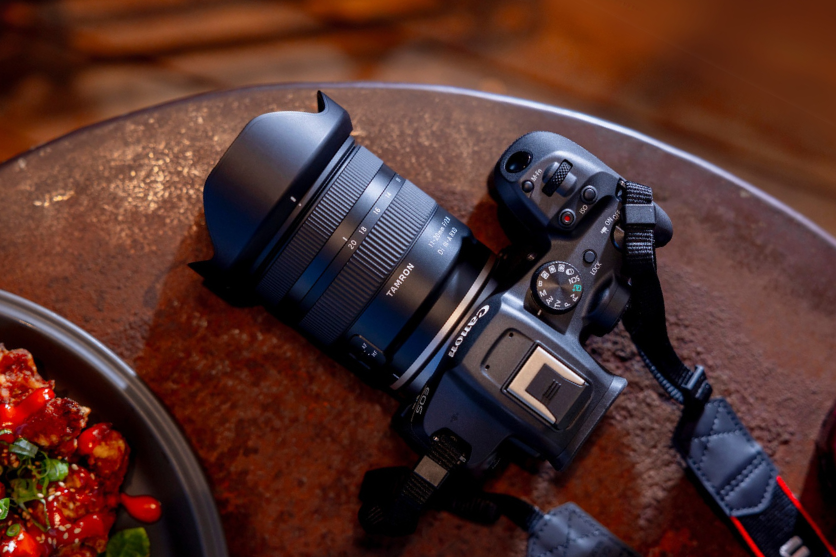
Canon’s mirrorless interchangeable-lens cameras use the RF mount, and a wide variety of lenses are available. This article focuses on Canon’s lenses for the RF mount and introduces how to select and recommend them. First, let’s gain a better understanding of Canon’s mounts for interchangeable-lens cameras and confirm the key points for lens selection.
Canon’s mounts for interchangeable-lens cameras
The joint connecting the camera body and the lens is called the lens mount. The standard for this mount differs depending on the camera manufacturer and model. For Canon interchangeable-lens cameras, there are mainly the CANON RF mount, Canon EF mount, and Canon EF-S mount. Let’s look at the features of each.
CANON RF mount
The CANON RF mount is Canon’s lens mount system for mirrorless interchangeable-lens cameras. One of its main features is its short flange back (distance from the mount surface to the image sensor). This allows for large-diameter lenses and a high degree of freedom in lens design, leading to the development of highly functional lenses. Data communication between the camera and lens is also faster, enabling more precise control.
It is also important to note that there are two types of lenses for the CANON RF mount: RF lenses for full-size cameras and RF-S lenses for APS-C size cameras.
Canon EF mount
The Canon EF mount is Canon’s lens mount system for full-size interchangeable-lens cameras and has a long history since its introduction in 1987. As a result, its extensive lens lineup is one of its most attractive features.
Canon EF-S mount
The Canon EF-S mount is a lens mount system for Canon’s APS-C size interchangeable-lens cameras. Lenses for the Canon EF mount can be mounted on the Canon EF-S mount, but lenses for the Canon EF-S mount cannot be mounted on the Canon EF mount.
Compatibility of CANON RF mount and Canon EF mount
CANON RF mount and Canon EF mount are not directly compatible. However, it is possible to mount a Canon EF mount lens on a CANON RF mount camera by using a mount adapter.
On the other hand, one point to be aware of is that there may be some functional limitations via an adapter. Therefore, when using a lens adapter, be sure to check in advance the scope of influence and the disadvantages of attaching it.
How to choose a lens for CANON RF mount
Canon’s RF mount lenses offer high performance and a wide variety of choices. However, the wide selection of lenses in the lineup can make it difficult to choose the right lens. Here, we will explain in detail the important points on how to select a lens for CANON RF mount.
1) Match with mount standard and sensor size
CANON RF mount interchangeable-lens cameras come in two types: models with full-size sensors and models with APS-C sensors. Basically, choose one that is compatible with the mount standard and sensor size of your camera body.
On the other hand, it is possible to mount a Canon RF lens for full-size cameras on an APS-C size camera body. In this case, due to the difference in image circle, the focal length will be converted to about 1.6 times the angle of view. Taking this as a reversal, it enables expression similar to that of a telephoto or Ultra-telephoto lens, and may be applied to photographing wild birds and wildlife.
2) Zoom lenses and prime lenses
There are two main types of lenses: zoom lenses and prime lenses. Zoom lenses have the advantage of being able to change the focal length, making it convenient to use a single lens for a wide variety of scenes.
On the other hand, prime lenses have a fixed focal length, but many models have excellent brightness and descriptive power. One disadvantage is that the distance to the subject needs to be adjusted by yourself, so it is also a lens that requires time to get used to.
Beginners should start with a zoom lens to get an idea of the distance and angle of view appropriate for the subject. Then, by adding a prime lens of a focal length you like, you can expand your photographic range and enjoy full-fledged photography.
3) Difference between focal length and angle of view
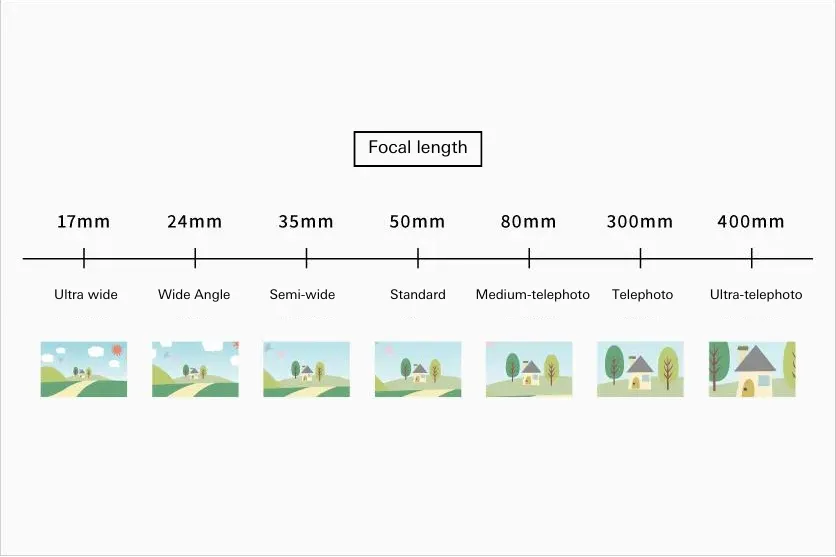
The angle of view changes depending on the focal length of the lens, and the range of photography and expression that can be achieved varies greatly.
In general, the angle of view is classified by focal length as follows
Ultra wide-angle (approx. 20 mm or less)
Wide Angle (approx. 35 mm or less)
Standard (approx. 50 mm or so)
Telephoto (approx. 80 mm or more)
Ultra-telephoto (approx. 300 mm or more)
The following is a brief description of the characteristics of each angle of view.
Ultra wide-angle lens

TAMRON 11-20mm F2.8 (Model B060) Focal length: 11mm Exposure: F8 Shutter Speed: 1/200sec ISO: 100
With a focal length of approximately 20 mm or less, Ultra wide-angle lenses have an extremely wide angle of view and can capture vast landscapes and even large architectural structures in the picture. Because it emphasizes perspective, it is ideal for dynamic compositions or when you want to strongly express spatial expansiveness. It is also suitable for shooting indoors where space is limited or shooting landscapes on narrow streets, as it provides a wide angle of view even when you are close to the subject.
Wide Angle lenses
Wide Angle lenses have a focal length of approximately 35 mm or less. They are suitable for shooting natural landscapes, cityscapes, and buildings. Like Ultra wide-angle lenses, they allow photographers to capture a wide range of subjects in a limited space, such as indoors or on narrow streets. Likewise, since perspective is emphasized, a sense of three-dimensionality and depth can be enhanced by using creative angles, allowing you to take impressive photographs with a sense of scale.
Standard lenses
With a focal length of around 50 mm, a standard lens has an angle of view close to the effective field of human vision. Since it captures the subject with a natural perspective, it is suitable for everyday photography such as portraits and snapshots. Its versatility in many other shooting situations, such as landscapes and table photography, also makes it attractive.
Telephoto Lenses
A telephoto lens is a lens with a focal length of approximately 80 mm or longer. The major advantage is the ability to take large pictures of distant subjects. They are suitable for shooting sports, vehicles, and animals, and are also used for portraits that take advantage of blurred backgrounds. Although the angle of view will be narrower, it can be used to create expressions such as cropping a subject out of a landscape.
In addition, the distance between the subject and the camera is compressed (compression effect), making distant objects appear closer to the subject. This effect can be used to emphasize the subject of a portrait or to create a sense of overwhelming scenery.
Ultra-telephoto lens
Ultra-telephoto lenses with a focal length of about 300 mm or more can capture subjects at greater distances. They are also used to photograph specific subjects, such as wary wild birds, distant athletes in sports, or even the moon or airplanes. Because the angle of view is even narrower than that of a telephoto lens, the subject can be conveyed loudly and clearly.
While it can capture the details of a subject in fine detail even from a distance, it is susceptible to camera shake, so a tripod is often required in many situations.
4) Weight and compactness
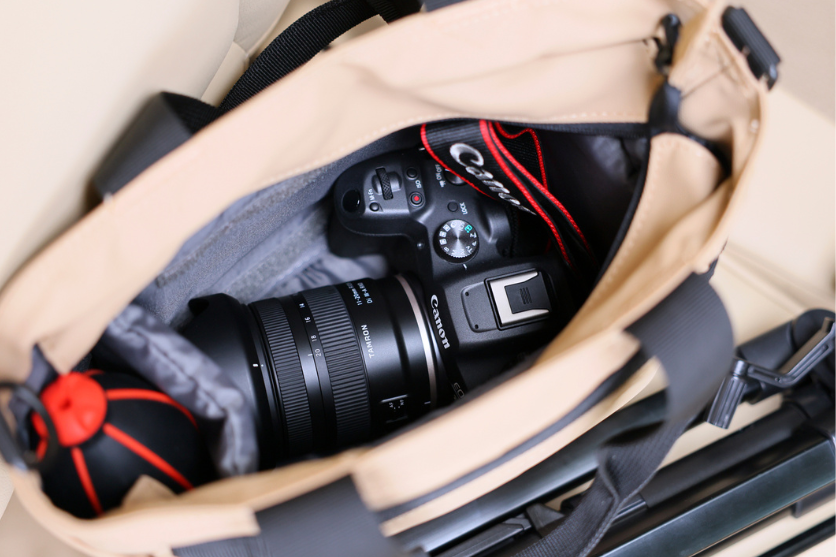
The weight of the lens and how it fits in the hand are also important when considering ease of daily use. A lightweight and compact lens is easy to take out and about and naturally provides more opportunities for shooting. It also makes your luggage less bulky when traveling or going on short excursions. Lightweight lenses that allow you to quickly set up the camera will be easier to use, especially for street snapshots where mobility is required.
5) F-number
The smaller this value, the more light can be captured by the sensor. For this reason, a lens with a small maximum aperture F-number is sometimes referred to as a “bright lens.
The advantage of a lens with a small maximum aperture F-number is that it produces beautiful bokeh and makes it easier to take brighter pictures even when shooting in dark places. For example, lenses with a maximum aperture of f/1.4 or f/2.8 have a shallow depth of field, making it easier to highlight the subject in portrait photography and to take high-quality photographs when shooting in low light conditions, such as night scenes or indoors.
6) Ease of use of focus ring and switches
When shooting, the lens must be operated flexibly and smoothly in accordance with the situation and subject at hand. Therefore, the operability of the lens is important.
For example, check that the focus ring moves smoothly and has an appropriate amount of resistance. It is also a good idea to check the placement and feel of various switches, such as the AF/MF switch and focus limiter. If these are arranged in an easy-to-use manner, you will be able to take pictures without stress.
7) Smoothness of AF (auto focus)
In addition to focusing accuracy, it is also important to check the smoothness of the AF and its ability to track moving objects. Tracking performance is especially important for subjects that move frequently, such as children, pets, animals, and sports. Also, if you are shooting video or in a quiet environment, consider how quiet the AF is.
8) In-Lens Image Stabilization Mechanism
The image stabilization mechanism is particularly effective with telephoto lenses and when shooting in low light conditions where shutter speeds are slower. It is also important in situations where it is difficult to use a tripod, such as when shooting landscapes or indoors. For this reason, it is important to check whether or not the camera has in-lens image stabilization and how well it works.
9) Minimum object distance

The minimum object distance is the shortest distance between the subject and the sensor within the visible range of focus. The shorter this distance, the closer you can get to the subject to capture greater detail. Even if you are not using a macro lens, you will be able to create an expression similar to that of a macro lens. This is a particularly important indicator when a wide range of expression is desired from a single lens.
10) Focus on descriptive performance

TAMRON 11-20mm F2.8 (Model B060) Focal length: 11mm Exposure: F2.8 Shutter Speed: 1/400sec ISO: 100
The descriptive performance of a lens varies by manufacturer and product, even for lenses with the same focal length and F-number. Check sharpness, contrast, color reproduction, bokeh, etc. In addition, your personal preferences will also have a large impact on the descriptive performance of a lens. Check sample photographs to see if the lens can produce the expression you envision for the subject or scene you want to photograph.
TAMRON’s Lens for CANON RF mount
TAMRON’s 11-20mm F/2.8 Di III-A RXD (Model B060) lens for CANON RF mount is designed for APS-C size mirrorless interchangeable-lens cameras and features a large aperture Ultra wide-angle zoom lens that is compact and lightweight. With a minimum object distance of 0.15m at the wide-angle end and a maximum magnification of 1:4, the lens has excellent close-up shooting capability, enabling wide macro photography with a good perspective. With its high descriptive performance and compact size, this lens is ideal for everyday use.
Select a lens for the CANON RF mount according to what you want to shoot and your style
In this article, we have explained the important points on how to choose a lens for CANON RF mount. Ultimately, what is important is to choose a lens that makes it easy to capture what you want to express. If possible, actually hold the lens in your hand to check its size and take test shots to see how descriptive it is. Although choosing the right lens can be a difficult task, try to imagine the kind of work you want to take and have fun with it.

Lens Featured in this Impression
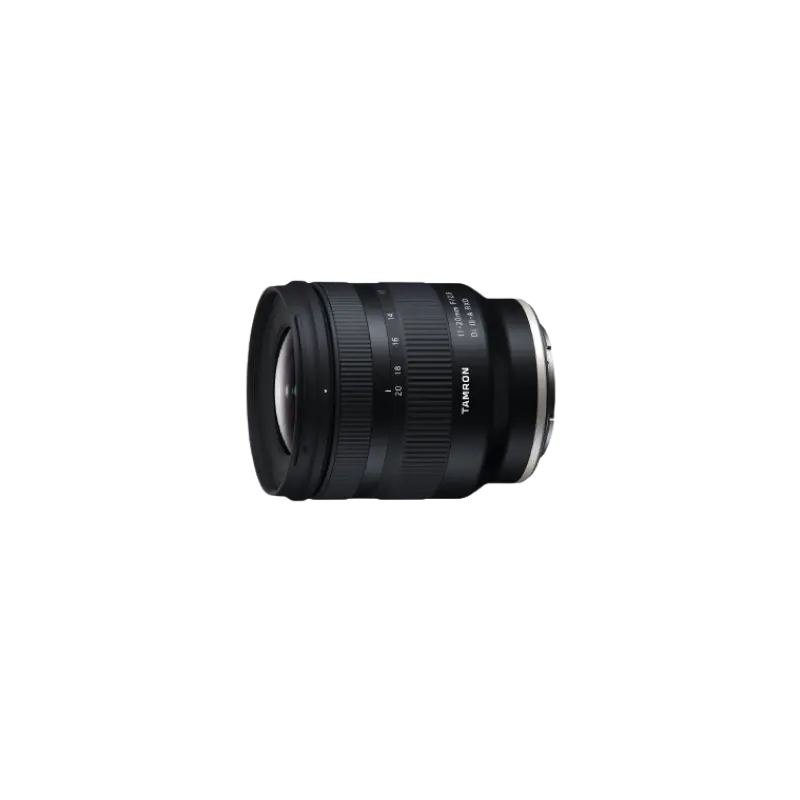
11-20mm F/2.8 Di III-A RXD (Model B060)
11-20mm F/2.8 Di III-A RXD (Model B060) is the world's first compact, lightweight F2.8 ultra wide-angle zoom lens for Sony E-mount APS-C mirrorless cameras. Can be a great choice for video shooting.
Learn more