
What Is APS-C? Understanding APS-C Sensors, Full-Frame Differences, and How to Choose the Right Lens
If you’ve been shopping for a mirrorless camera or looking for a new lens, you’ve probably come across the term APS-C.
But what exactly does APS-C mean?
APS-C refers to a type of image sensor used in interchangeable-lens cameras. Compared with a full-frame sensor, an APS-C sensor is smaller, which affects how much of a scene the camera captures with a particular lens, how much background blur you can achieve, and the overall size and weight of the camera system.
APS-C cameras are widely used by beginners, enthusiasts, and professionals because they can offer a practical combination of image quality, portability, and versatility.
The smaller sensor can also be useful for subjects such as wildlife and sports because the narrower angle of view can make a telephoto lens appear to provide more reach.
However, choosing between APS-C and full-frame isn’t simply about which format is better.
Each sensor size has different characteristics, and the right choice depends on what and how you photograph.
In this article, we’ll explain what APS-C is, how an APS-C sensor compares with a full-frame sensor, what the crop factor means, how sensor size affects your photographs, and what to consider when choosing an APS-C lens.
What Is APS-C?
APS-C is one of the common sensor sizes used in interchangeable-lens cameras.
The name comes from Advanced Photo System type-C, a film format that had a similar size.
There isn’t one exact APS-C sensor dimension used by every manufacturer.
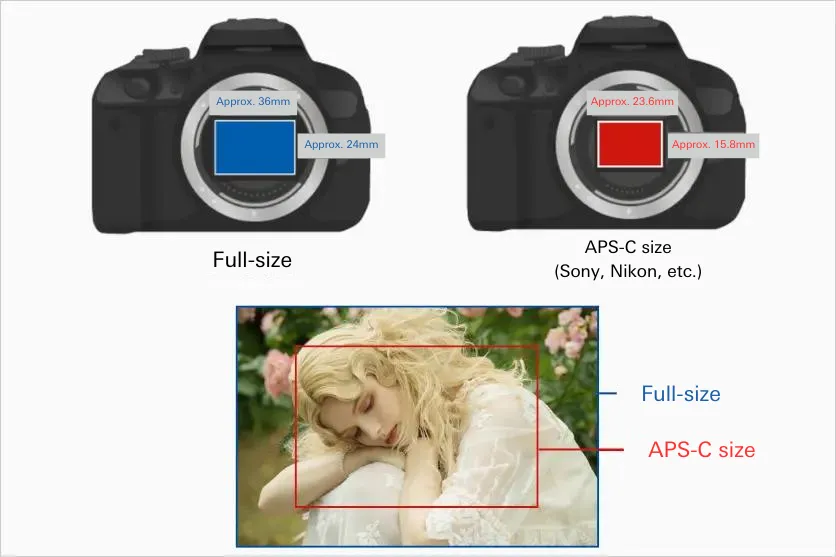
For example, Sony and Nikon APS-C sensors are approximately 23.6 × 15.8mm, while Canon’s APS-C sensors are approximately 22.3 × 14.9mm. TAMRON notes that APS-C does not have one strict sensor-size standard, so dimensions can vary somewhat between manufacturers.
By comparison, a full-frame sensor is approximately 36 × 24mm, corresponding to the size of a 35mm film frame.
The difference in physical size is important because the sensor determines how much of the image projected by the lens is recorded.
APS-C vs Full-Frame: What’s the Difference?
The easiest way to understand the difference is to imagine using the same lens from the same position.
The full-frame sensor captures a larger portion of the image projected by the lens.
The smaller APS-C sensor captures a smaller portion of that same image.
As a result, the APS-C photograph has a narrower angle of view.
This difference affects several aspects of photography, including:
- Angle of view
- Effective focal length
- Background blur
- Low-light performance
- Dynamic range
- Camera and lens size
- Portability
Let’s look at each one in more detail.
1. Sensor Size
The most fundamental difference is the physical size of the sensor.
A typical full-frame sensor measures approximately:
36 × 24mm
An APS-C sensor is smaller, with dimensions varying depending on the manufacturer.
For example:
Sony/Nikon APS-C: approximately 23.6 × 15.8mm
Canon APS-C: approximately 22.3 × 14.9mm
Because the APS-C sensor is smaller, it captures a narrower portion of the image produced by the lens.
This difference is the foundation for many of the other characteristics associated with APS-C cameras.
2. Angle of View
One of the easiest differences to see when using APS-C is the angle of view.
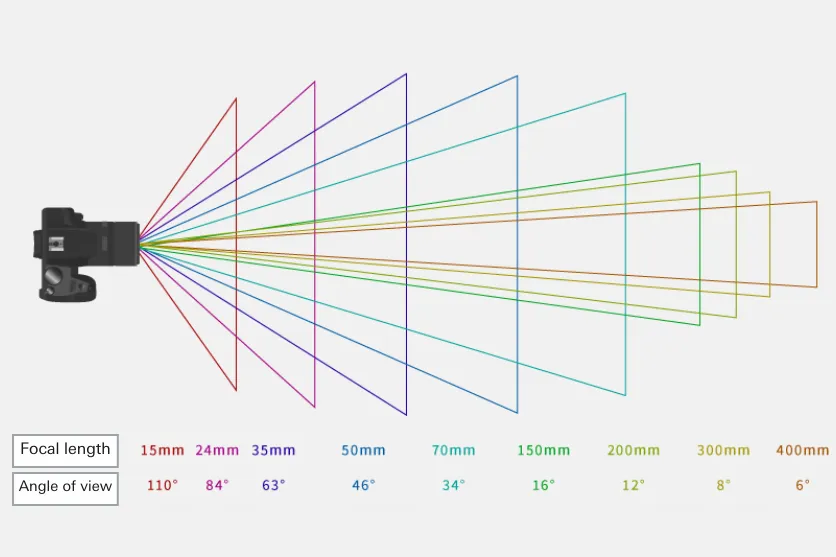
Imagine mounting the same 50mm lens on both a full-frame camera and an APS-C camera.
From the same shooting position, the full-frame camera captures a wider area.
The APS-C camera captures a narrower area.
This is sometimes described as a crop effect.
It doesn’t mean that the lens itself has physically changed from 50mm to a longer focal length.
Rather, the smaller sensor records a smaller portion of the lens’s image circle.
What Is the APS-C Crop Factor?
This is where the concept of 35mm-equivalent focal length becomes useful.
As a general guide, APS-C cameras have a crop factor of approximately 1.5× to 1.6×, depending on the manufacturer.
For example, on a 1.5× APS-C system:
50mm × 1.5 = 75mm equivalent
This means a 50mm lens on a 1.5× APS-C camera provides a field of view approximately comparable to a 75mm lens on full-frame.
With Canon’s approximately 1.6× crop factor:
50mm × 1.6 = 80mm equivalent
Again, the physical focal length of the lens remains 50mm.
The calculation simply helps you understand the field of view relative to a full-frame camera.
APS-C Focal Length Examples
Here’s a simple reference using an approximate 1.5× conversion:
| APS-C Lens | Approx. Full-Frame Equivalent |
|---|---|
| 10mm | 15mm |
| 16mm | 24mm |
| 18mm | 27mm |
| 24mm | 36mm |
| 35mm | 52.5mm |
| 50mm | 75mm |
| 70mm | 105mm |
| 100mm | 150mm |
| 200mm | 300mm |
| 300mm | 450mm |
| 400mm | 600mm |
The actual conversion depends on the camera manufacturer’s crop factor.
3. Bokeh and Depth of Field
Sensor size also affects how background blur appears.
When photographing the same subject at the same angle of view, a full-frame camera can generally produce more background blur than an APS-C camera when comparable framing and aperture conditions are used.
This is related to the differences in focal length and camera-to-subject distance required to achieve the same framing.
APS-C cameras can still produce beautiful bokeh.
A lens with a wide maximum aperture, such as F2.8, can provide significant background separation.
However, when the goal is extremely shallow depth of field, full-frame systems generally have an advantage when comparing equivalent framing.
TAMRON notes that, when photographing the same subject at the same angle of view, full-frame cameras generally produce greater background blur than APS-C cameras.
APS-C Can Still Be Great for Portraits
The difference in bokeh doesn’t mean APS-C cameras aren’t suitable for portraits.
Quite the opposite.
An APS-C camera paired with a bright lens can produce attractive subject separation.
For example, a standard zoom with an F2.8 aperture can provide a useful combination of:
- Subject separation
- Flexible framing
- Low-light capability
- Versatility
The slightly greater depth of field can even be useful when you want more of the subject’s face to remain sharp.

4. Dynamic Range
Another difference between sensor formats can be dynamic range.
Dynamic range describes the range between the darkest and brightest portions of an image that a sensor can capture with useful detail.
A larger sensor can generally provide advantages in light-gathering capability and tonal performance, although actual image quality depends on many factors, including sensor design, generation, pixel count, processing, and exposure.
In general, full-frame sensors tend to offer greater potential for dynamic range than smaller sensors when comparing otherwise similar technologies. TAMRON describes full-frame sensors as generally offering wider dynamic range and smoother tonal gradations.
This can be particularly useful in scenes containing both very bright and very dark areas.
For example:
- Sunsets
- Backlit landscapes
- High-contrast architecture
- Interiors with bright windows
- Night scenes
However, modern APS-C cameras can also deliver excellent image quality, particularly when exposure is controlled carefully.

5. High-ISO and Low-Light Photography
Sensor size can also influence low-light performance.
When photographing in dark conditions, photographers often increase ISO sensitivity.
Higher ISO settings can introduce visible noise.
Because full-frame sensors have a larger light-gathering area, they generally have an advantage in high-ISO image quality when comparing sensors of similar technology. TAMRON notes that full-frame cameras generally produce less noise at high sensitivities because of their larger sensors.
However, this doesn’t mean an APS-C camera can’t be used for:
- Night photography
- Indoor photography
- Concerts
- Events
- Street photography
- Evening travel photography
A bright lens can make a significant difference.
A lens with an F2.8 maximum aperture, for example, allows more light into the camera than a slower lens.
Good exposure technique and modern camera processing also help.
6. Size and Weight
One of the most noticeable practical advantages of APS-C systems is portability.
Because the sensor is smaller, camera bodies and lenses can often be designed to be smaller and lighter.
This can make a significant difference when traveling.
Imagine carrying your camera for an entire day while visiting:
- A city
- A museum
- A mountain
- A wildlife park
- A festival
- A tourist destination
A smaller system can be easier to carry and handle.
TAMRON specifically highlights compactness and portability as important advantages of APS-C systems, particularly for photographers who travel or spend significant amounts of time shooting outdoors.
Of course, camera and lens size varies considerably, and modern full-frame systems can also be surprisingly compact.
So it is better to compare the actual camera-and-lens combination rather than assuming that every APS-C system is smaller than every full-frame system.
Why Choose an APS-C Camera?
There are several reasons a photographer might choose APS-C.
Compact System
APS-C cameras can provide a smaller overall system.
This is useful for photographers who prioritize portability.
Telephoto Reach
The narrower field of view can be helpful for distant subjects.
This makes APS-C particularly interesting for:
- Wildlife
- Birds
- Sports
- Outdoor activities
Versatile Lens Options
APS-C systems include lenses designed specifically for the smaller sensor.
These lenses can offer useful focal-length ranges while maintaining relatively compact designs.
Easier to Carry
A smaller camera and lens combination can encourage you to bring your camera with you more often.
And having your camera with you is often more important than having the largest possible setup.
How to Choose an APS-C Lens
Once you have an APS-C camera, choosing the right lens becomes the next important step.
Don’t simply look at the focal length.
Consider how the lens will actually be used.
Here are several characteristics worth checking.
1. Make Sure the Lens Is Compatible
The first thing to check is whether the lens is compatible with your camera’s:
- Mount
- Sensor format
- Autofocus system
- Electronic communication
Lens mounts vary between manufacturers.
Even lenses designed for the same sensor size may not be interchangeable between different camera systems.
Always check the lens specifications before purchasing.
APS-C Lens vs Full-Frame Lens
There are lenses specifically designed for APS-C cameras and lenses designed for full-frame cameras.
An APS-C lens generally produces an image circle sized for the smaller sensor.
A full-frame lens produces a larger image circle that can cover a full-frame sensor.
A full-frame-compatible lens can often be used on an APS-C camera when the mount is compatible.
In this situation, the APS-C sensor simply records a smaller portion of the image circle.
However, an APS-C-specific lens mounted on a full-frame camera may cause vignetting because the image circle may not cover the entire full-frame sensor. TAMRON notes that APS-C lenses can produce darkened corners when used on a full-frame camera, although some camera bodies provide an APS-C crop mode.
Always check the specific camera and lens compatibility before using them together.
2. Consider the Focal Length
Think about what you photograph most often.
For landscapes and architecture, you may want a wide-angle lens.
For everyday photography, a standard zoom can provide greater flexibility.
For portraits, a short telephoto range can provide flattering perspectives.
For wildlife and sports, a longer telephoto lens can help you fill the frame with distant subjects.
Remember to consider the APS-C crop factor when thinking about field of view.
3. Check the Maximum Aperture
The maximum aperture tells you how much light the lens can transmit at its widest setting.
A smaller F-number means a wider maximum aperture.
For example:
F2.8 is wider than F4.
A wider aperture can be useful for:
- Low-light photography
- Indoor photography
- Portraits
- Sports
- Wildlife
- Background separation
TAMRON notes that a smaller maximum F-number allows more light to enter the camera and can make it easier to photograph in dark environments and create background blur.
4. Look at Minimum Object Distance
Minimum Object Distance, or MOD, describes the shortest distance at which the lens can focus on a subject.
A lens with a short minimum focusing distance can be useful for photographing relatively small subjects.
For example:
- Flowers
- Food
- Accessories
- Small products
- Insects
- Everyday objects
This can add another layer of versatility to an APS-C lens.
TAMRON specifically highlights minimum object distance as a useful specification to consider when choosing a lens because a short MOD can expand the range of subjects you can photograph.
5. Consider the Zoom Ratio
For zoom lenses, the zoom ratio describes the relationship between the longest and shortest focal lengths.
For example, an 18-300mm lens has:
300 ÷ 18 = approximately 16.7× zoom
A high zoom ratio allows one lens to cover a broad range of focal lengths.
This can be useful for travel photography because you can move from wide compositions to telephoto subjects without changing lenses.
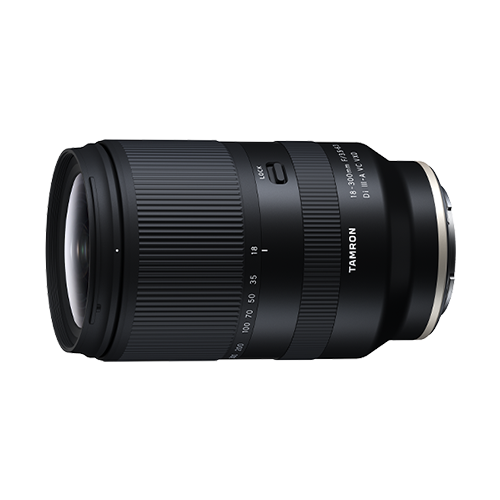
TAMRON uses the 18-300mm F3.5-6.3 Di III-A VC VXD (Model B061) as an example of a high-zoom-ratio APS-C lens, with a 16.6× zoom ratio.
6. Autofocus Performance
Autofocus is another important consideration.
Fast and accurate AF can be particularly useful when photographing moving subjects.
For example:
- Children
- Sports
- Wildlife
- Birds
- Street scenes
If you also shoot video, pay attention to autofocus smoothness and noise.
A lens with quiet autofocus can make it easier to record video without unwanted focusing sounds being picked up by the microphone.
7. Vibration Compensation
Telephoto photography can make camera shake more noticeable.
This is especially important when using APS-C cameras with long focal lengths.
A lens equipped with Vibration Compensation (VC) can help reduce the effects of camera shake when shooting handheld.
VC can be particularly useful when:
- Shooting outdoors
- Photographing wildlife
- Traveling
- Working in low light
- Using longer focal lengths
- Shooting without a tripod
However, image stabilization does not freeze a moving subject.
If you’re photographing a running animal or sports player, you still need an appropriately fast shutter speed.
APS-C for Travel Photography
APS-C cameras can be particularly useful for travel photographers.
When traveling, you may want to photograph many different subjects in a single day.
You might start with a landscape in the morning, photograph architecture in the afternoon, capture food at lunch, and then photograph people or wildlife later.
Carrying several specialized lenses can become inconvenient.
An APS-C camera paired with a versatile zoom can reduce the amount of equipment you need to carry.
For example, an all-in-one lens covering a broad focal-length range can allow you to photograph both wide scenes and distant subjects without changing lenses.
This can also help when traveling in situations where changing lenses isn’t convenient.
APS-C for Wildlife and Bird Photography
The narrower field of view provided by APS-C can be useful when photographing distant subjects.
Suppose you’re photographing a bird using a 300mm lens.
On a 1.5× APS-C system:
300mm × 1.5 = 450mm equivalent
Again, the lens remains physically 300mm.
The camera simply captures a narrower portion of the lens’s image.
This can help the bird occupy more of the frame.
The same principle applies to wildlife and sports.
However, remember that the crop factor doesn’t create additional optical magnification.
The subject isn’t actually closer.
You’re simply recording a smaller portion of the lens’s image.

APS-C for Sports Photography
Sports photographers often need long focal lengths because they cannot always get physically close to the action.
An APS-C camera’s narrower field of view can be useful here.
Pairing an APS-C camera with a telephoto lens can provide a practical combination of reach and portability.
For example, a 200mm lens on a 1.5× APS-C system provides a field of view roughly comparable to 300mm on full-frame.
This can help you fill the frame with an athlete without carrying an even longer lens.
APS-C for Landscape Photography
APS-C cameras are also capable of excellent landscape photography.
The important consideration is choosing a sufficiently wide lens.
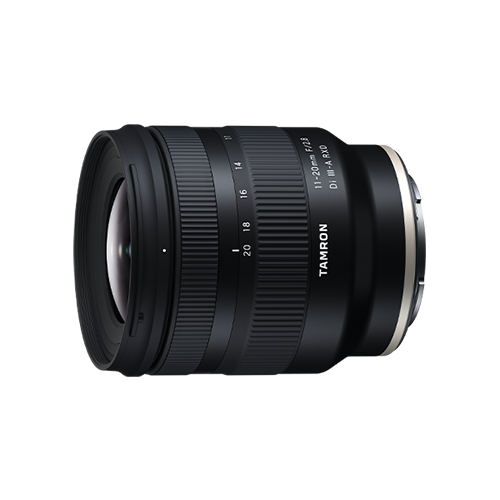
A lens such as the TAMRON 11-20mm F2.8 can provide an ultra-wide field of view on an APS-C camera.
This makes it possible to photograph:
- Mountains
- Beaches
- Architecture
- Forests
- Large interiors
- Cityscapes
Remember that a 17mm lens on APS-C does not provide the same field of view as 17mm on full-frame.
This is why understanding the crop factor is important when selecting your lens.
APS-C and Full-Frame: Which One Should You Choose?
There isn’t one format that is right for every photographer.
Instead, think about what matters most to you.
APS-C may be attractive if you prioritize:
- Compact equipment
- Lower overall weight
- Travel convenience
- Telephoto reach
- Outdoor photography
- Wildlife
- Birds
- Sports
- A versatile camera system
Full-frame may be attractive if you prioritize:
- A wider field of view
- Strong low-light performance
- Greater potential for shallow depth of field
- High dynamic range
- Full-frame lens selection
These are general characteristics rather than strict rules.
A modern APS-C camera can produce excellent photographs, and a compact full-frame system can also be highly portable.
The most important consideration is how the complete camera-and-lens system fits your style of photography.
APS-C Sensor: A Simple Way to Understand It
If you’re still unsure about APS-C, remember these four points:
1. APS-C has a smaller sensor than full-frame.
2. The smaller sensor gives a narrower angle of view with the same lens.
3. The narrower field of view can be useful for telephoto photography.
4. APS-C systems can offer a compact and lightweight combination of camera and lenses.
Once you understand these basic ideas, choosing APS-C lenses becomes much easier.
APS-C Lens Selection Checklist
Before purchasing an APS-C lens, consider:
Sensor compatibility
Is the lens designed for APS-C or full-frame?
Mount compatibility
Does the lens mount match your camera?
Focal length
What angle of view do you need?
35mm equivalent
Have you considered the crop factor?
Maximum aperture
Do you need a bright F2.8 or wider aperture?
Minimum focusing distance
Do you photograph small or nearby subjects?
Zoom range
Would one versatile lens be more useful than several lenses?
Autofocus
Will you photograph moving subjects?
Image stabilization
Would VC or another stabilization system be useful for handheld shooting?
Size and weight
How much equipment are you comfortable carrying?
Final Thoughts on APS-C Cameras and Lenses
Understanding what APS-C is makes it much easier to choose a camera and lens system that fits your photography.
APS-C sensors are smaller than full-frame sensors, which results in a narrower angle of view when using the same focal length from the same shooting position.
The approximate 1.5× to 1.6× crop factor can be particularly useful when photographing distant subjects, giving lenses a narrower field of view that can be advantageous for wildlife, birds, and sports.
APS-C systems can also offer the practical advantage of compact and lightweight equipment, making them particularly attractive for travel and outdoor photography.
At the same time, full-frame cameras can offer advantages in areas such as low-light performance, dynamic range, and shallow depth of field.
Neither format needs to be treated as universally better.
Instead, consider the type of photography you enjoy.
If portability, versatility, and telephoto reach are important to you, an APS-C camera can be a highly capable choice.
Once you’ve chosen your camera, select lenses based on the subjects you photograph most often.
For wide-angle work, consider an ultra-wide APS-C lens such as the TAMRON 11-20mm F2.8 Di III-A RXD.
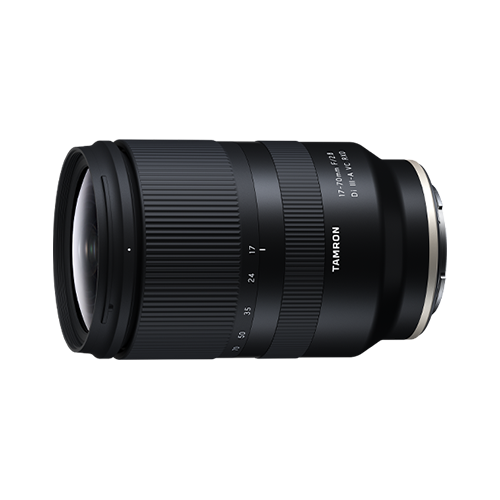
For everyday photography, travel, portraits, and video, the 17-70mm F2.8 Di III-A VC RXD provides a versatile range.
And if you want a single lens that can cover everything from wide-angle scenes to distant subjects, the 18-300mm F3.5-6.3 Di III-A VC VXD provides an exceptionally broad focal-length range for an APS-C system.
Understanding your sensor size, focal length, aperture, and shooting requirements will help you choose equipment that matches the way you actually photograph.
The more you understand how your APS-C camera and lens work together, the more confidently you can make the most of the system—and concentrate on creating the photographs you want.
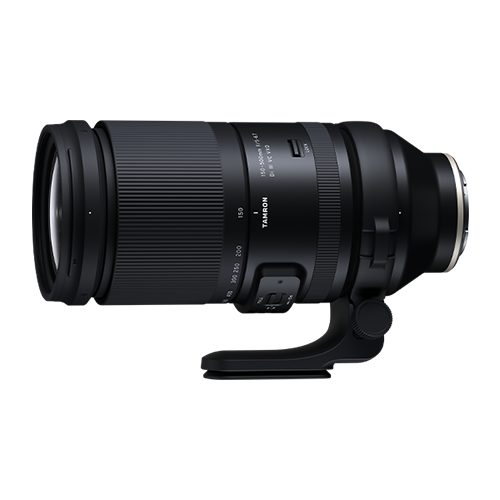
TAMRON products mentioned in this article